The Research, Policy, Planning within the Ministry of Women, Youth, Children and Family Affairs is the responsibility of the Research, Policy, Planning and Information Division

The following are some of the roles played by the Division:

  • Coordinate and support research, policy and planning activities
  • Coordinate data collection, processing and dissemination of information
  • Support monitoring of Policies, Plans and Programmes of the ministry
  • Establish and support effective and reliable communication networks with key stakeholders and back that network up with reliable information/data system that government can base its policy initiatives upon, and stakeholders can use to coordinate their programme assistance.

Policy & Planning Documents…

Strategic Plans & Policies

IEC Documents

Within the Institutional Framework for Disaster Management in the Solomon Islands, the Protection Committee is one of six committees established under section 97 of the NDMP, under the national Disaster Operations Committee (N-DOC). It is chaired by the Ministry of Women, Youths, Children and Family Affairs (MWYCFA).


Protection in Solomon Islands disaster management

The Solomon Islands Government (SIG) has adopted the regional Framework for Resilient Development in the Pacific (FRDP) of which the third goal is of utmost relevance to the work of the Protection Committee, for strengthened disaster preparedness, response and recovery. Included in the priority actions are: the use of sex and age disaggregated data and data for vulnerable groups, inclusive and gender-responsive decision-making systems, human rights-based approaches, ensuring messaging on humanitarian services reaches vulnerable people, protection of individuals and communities, gender-sensitive disaster preparedness and response arrangements, addressing the specific needs of vulnerable groups, a culturally inclusive approach, and supporting the protection of individuals and communities most vulnerable to post-disaster displacement and migration.

The SIG takes a proactive approach to disaster management, and recognises that, while disasters can affect anyone, the most vulnerable people are often most affected, and without specific focus, can face a long and difficult road to recovery. Disasters may compromise the safety, wellbeing, and dignity of disaster-affected people, and may exacerbate any pre-existing gender inequalities and protection challenges relating to social discrimination, exclusion, violence, abuse, exploitation, or neglect of vulnerable individuals/groups (e.g. women, girls and boys, older people, and people with different abilities and identities).

Protecting human rights and promoting equality is central to humanitarian action and in disaster preparedness, response, and recovery. The situation, needs, vulnerabilities, capacities and opportunities of women, girls, boys and men are different. Understanding those differences enables preparedness activities which reduce vulnerability and improve resilience, and response activities which are inclusive, participatory, non-discriminatory, do not cause harm, and promote gender equality and women’s empowerment.

The NDMP has a strong focus on protection, including “community inclusiveness – including gender, the needs of marginalised groups, those in remote locations, those with disabilities and the elderly”, and “recognises community and individual rights and is based on a concern for equity and fairness and for gender and minority group issues”. A core response function of disaster management operations is protection, gender and child specific issues of welfare and safety, and the needs of vulnerable or marginalised groups, and similarly at the village level, “particular attention shall be given to the first line protection and needs of women, children and other vulnerable groups” such as people with disabilities. The specific role of women in disaster management is underscored in the NDMP, including that “the involvement of women in arrangements at all levels is critical”, and sections 60, 71 and 91 set out mandatory requirement including there being at least two women in each committee, working group or team addressing relief distribution and shelter. The PC endorses the role of women, and also endorses inclusion of the range of diversity within society, in decisions and actions relating to disaster management.

Key concepts

In addition to the definitions in section 32 of the NDMP, the following key concepts and terms apply to this TOR:

Protection  refers to all activities aimed at obtaining full respect for the rights of the individual in accordance with the letter and the spirit of the relevant bodies of law, which includes human rights law, international humanitarian law, and refugee law. In a solely natural disaster context, the focus is on the human rights of disaster-affected individuals, including their safety, their right to impartial and non-discriminatory access to assistance based on needs, to be informed and heard, and to meaningfully participate in the design and implementation of assistance activities.

Two areas of protection which have specific focus are child protection and gender-based violence:

Child protection  refers to efforts directed towards preventing and responding to violence, exploitation, abuse and neglect against children.

Gender-based violence refers to violence that targets individuals or groups on the basis of their gender. This includes acts that inflict physical, mental or sexual harm or suffering, the threat of such acts, coercion and other deprivations of liberty, and includes economic violence. Although GBV can affect anyone, it is predominantly experienced by women and girls.

Gender refers to the social roles and responsibilities of women, men, boys and girls of different ages. It encompasses behaviour that is expected and rewarded; power to make decisions, be heard, and own and control resources; as well as access to employment, education, information and basic services. Gender is socially constructed and learned; it varies over time and from culture to culture. Women and men, boys and girls continue to have the same rights in times of disaster, but for gender reasons their different needs, capacities, vulnerabilities, opportunities, perspectives, and experiences.

Vulnerability in the broader disaster context, as defined in section 32 of the NDMP, is the extent to which a community’s structure, services and environment is likely to be damaged or disrupted by the impact of a hazard. In a protection context, vulnerability refers to the characteristics of a person or group and their situation within a community’s structure, services and environment,that influence their capacity to cope with and recover from impacts. Some people’s underlying vulnerabilities can create disproportionate impacts and protection risks, especially for the young and the elderly, people with disabilities and specific vulnerabilities, and other diversity. 

Disability refers to long-term physical, mental, intellectual or sensory impairments, which in interaction with various attitudinal and environmental barriers hinder a person’s full participation in society on an equal basis.

Key principles

In addition to the key principles set out in section 17 of the NDMP, including self-help, sustainability and community inclusiveness, the PC is guided by the following principles.

Humanity: committee members work to prevent and alleviate human suffering wherever it is found, and to protect life and health and ensure respect for human beings.

Impartiality: humanitarian action is based on need alone, giving priority to the most urgent cases of distress and making no distinctions on the basis of nationality, race, gender, religious belief, class, political opinions or other grounds.

Neutrality: humanitarian actors do not take sides in tensions or hostilities or engage in controversies of a political, racial, religious or ideological nature.

Independence: humanitarian action is autonomous from the political, economic, military or other objectives of any actor in places humanitarian action is implemented.

State sovereignty: states have the primary responsibility to protect all individuals within their jurisdiction in accordance with national and international laws. 

Partnership: where appropriate and requested, humanitarian actors assist states to protect the safety, dignity and rights of disaster-affected people. Government and humanitarian actors apply the partnership principles of equality, transparency, complementarity, responsibility and effectiveness through a results-oriented approach, and implement the primary driver of self-help through partnership with local stakeholders.

Respect: committee members respect local systems and processes, culture and customs, and diversities in gender, age, disability, identity, ethnicity and other factors, except insofar as they create harm or perpetuate inequality or discrimination.

Equality: committee members recognise the importance of modelling equality in its own work, including externally with responders and communities, and internally with equal participation of men and women members, and mutual respect for the different and valuable contribution of national and international members.

Do No Harm: humanitarian action should not create harm or increase the risks that disaster-affected people face, nor undermine self-reliance or create dependency.

Accountability to affected populations: disaster-affected people have the right to participate in decisions that affect their lives, to receive information they need to make informed decisions, to provide feedback or make a complaint, and to be free from sexual and other forms of exploitation and abuse.

Protection Committee

Purpose

The purpose of the Protection Committee at the national level is to prevent, reduce and alleviate human suffering resulting from disasters, through the integration of protection in disaster management arrangements.

Scope

The geographical scope of the Protection Committee is national, and is complemented by Provincial Protection Committees (PPCs) established pursuant to section 69 of the NDMP, as the primary responders under the respective Provincial Disaster Operations Committees (P-DOCs).

The scope of work includes targeted action for protection, including for displaced populations, and thematic areas such as child protection, gender-based violence, and protection of specific groups such as persons with disabilities; and support for protection mainstreaming by other disaster responders including N-DOC, NEOC, NERT, other N-DOC Committees and other stakeholders covered by the NDMP, which each have a responsibility to ensure protection is systematically integrated throughout preparedness, response and recovery.

The Protection Committee is a standing body, engaged in normal times in preparedness activities, and escalating to response in times of emergency, and later transitioning to response.

The focus of the Protection Committee is on declared disasters as defined in section 32 of the NDMP, and the PC recognises the primary role of the RSIPF in promoting safety and security and that, under the SOI Red Cross Act, the SOI Red Cross takes the lead on humanitarian response to isolated or smaller scale incidents. As part of its preparedness function, the PC has a watching brief on these matters, and may if appropriate undertake advocacy or dissemination of key messages or other actions to pre-emptively reduce the humanitarian consequences of any escalation.

Functions

The functions of the Protection Committee are set out in section 103 of the NDMP as follows:


These complement the general functions of disaster management operations, listed in section 89 of the NDMP, which the Protection Committee contributes towards. Accordingly, the functions of the Protection Committee are:

Preparedness

  • Raise awareness of the centrality of protection in disaster management and advocate for affected populations to be at the forefront of disaster preparedness, response and recovery, ensuring inclusion and participation of under-represented groups, promoting quality intervention and supporting self-reliance; advocate for women’s inclusion and leadership in preparedness activities, processes and structures;
  • Develop capacity of persons and entities covered by the NDMP integrate protection in their efforts during preparedness, response and recovery, including the application of minimum standards for quality response;
  • Develop an evidence base to support appropriate implementation of protection through analysis of secondary data, conducting research and preparing reports from needs assessments, lessons learned and other activities;
  • Develop appropriate tools, templates, standards, resources and processes for targeted action and mainstreaming; and
  • Protection Disaster Plan preparation, to be ready to respond in a disaster.

Response

  • Undertake information management functions to identify protection issues through the use of appropriate rapid assessment tools, analysis of data and its use in strategic response planning and resource mobilisation;
  • Protection advocacy, including magnifying visibility and voice for people who may be overlooked or excluded in disaster management processes and assistance;
  • Support, advocate for and implement actions to improve the inclusion of women as responders and women’s leadership in humanitarian/emergency response;
  • Targeted actions in relation to GBV, children, people with disabilities, older people and other vulnerable groups; and
  • Implement, monitor, evaluate, and engage in accountability and learning for continuous improvement;
  • Advocate for and support with the design and/or implementation of a practical mechanism for community feedback and complaints, including a system for referral and response to complaints, and reporting back to complainants, and ensuring confidentiality and protection of those who use the mechanism; and
  • Support mainstreaming of protection by other responders and promote overall rights-based access to basic social services of disaster-affected people.

Recovery

  • Monitoring recovery activities of all responders to ensure that those with the greatest needs and vulnerabilities are given priority, and advocate for those who may be overlooked or excluded;
  • Implementation of ongoing response-related activities such as psychosocial support and support to the safety and protection of women, children and other vulnerable people;
  • Ensure strong linkages and information flows between the Protection Committee and the relevant Provincial Protection Committees or other provincial-level coordination structures, in the transition from response to recovery;
  • Provide protection input to the recovery plan developed under the work of the Recovery Coordination Committee;
  • Coordinate and advocate for allocation of financial resources for the implementation of protection-related recovery activities; and
  • Implement protection-related recovery activities under the agreed recovery plan.
The Gender Equality and Women’s Development (GEWD) Policy 2016 – 2020 (link to document) is the overarching policy framework for achieving gender equality and women’s human rights in Solomon Islands.

Other national and international frameworks and commitments for gender equality and human rights which the Solomon Islands Government has adopted such as the Convention on the Elimination of All forms of Discrimination against Women (CEDAW) and the Sustainable Development Goals (SDGs) is fundamental to the purpose of this Policy.

The Policy is premised on the vision that gender equality contributes substantially to improving the wellbeing of women, men, girls and boys—and that the promotion of gender equality must be at the heart of the government’s mission.

It recognizes that continuing to invest in women’s empowerment is vital to achieving gender equality and recognises the need for women and men to work together to address attitudinal and institutional barriers to gender equality.

Policy Priority Outcomes

  1. Gender responsive government programmes and services.
  2. Improved economic status of women.
  3. Equal participation of women and men at all levels of decision-making, governance and leadership.
  4. Preventing and responding to violence against women and girls.
  5. Increased awareness and acknowledgement of the role of women in peace and security.
  6. Increased access to education and providing a supportive school environment.
  7. Improved access for women’s right to sexual and reproductive health.

Gender Responsive Government Programmes and Services

The delivery of gender responsive programmes and services requires a good understanding of the diversity of needs that women and men have across all spheres of their lives.

Although the Ministry plays a strategic role in advancing gender mainstreaming across the Solomon Islands Government, it is the responsibility of all government sectors and ministries to support the process. While efforts have been made to integrate women’s concerns into some sector policies, plans and processes, more systematic efforts need to be made to achieve significant results.

In 2014, gender focal points were appointed in each ministry as part of the Public Service Commission reform processes. The role of the focal points is to support senior managers in the institutionalisation of gender mainstreaming within the ministry.

The gender focal point system is a key entry point for supporting the achievement of a gender responsive government programmes and services.  The MWYCFA will continue to provide technical advice and support to gender focal points in order to strengthen their ability to undertake gender analysis and to build a cadre of civil servants with gender expertise.

Equal Participation of Women & Men at all Levels of Decision making, Governance & Leadership

Women are underrepresented in all levels of decision making in the Solomon Islands. Although there has been an increase in the number of women in senior and mid-level public service positions, representation of women in parliament remains very low.

  • Only 5% of senior public servant positions and 22% of mid-level positions are occupied by women (ADB 2015).
  • 2014 to current – only 3 out of 24 Permanent Secretaries are women.
  • Women represented 6% of all candidates in the 2014 national election. There were 26 women candidates, unchanged from the number contesting the 2010 election.
  • 1993 to current – only 5 female Parliamentarians.

The Ministry and partners in the Women in Shared Decision Making coalition have been active nationwide, promoting the need for TSMs to be introduced at the national and provincial government level. The Ministry together with Provincial Women Leaders and national stakeholders advocate to include TSM in the Provincial Government Act amendments.

Preventing and responding to violence against women and girls

Violence against women and girls is too common in Solomon Islands. Nearly two in three women between the age of 15 and 49 have experienced violence.

Results of the 2009 Family Health and Safety Survey also shows that 42% of young women who had their first sexual experience before the age of 15 reported that it was forced. Violence against women and girls is condoned. The majority of women, 73% believe that a man is justified in beating his wife under some circumstances, in particular, for infidelity and disobedience.

Solomon Islands Government recognises the growing gender inequalities and high prevalence of violence against women and girls and commits to several global and regional commitments to gender equality including the Convention on the Elimination of all Forms of Discrimination against Women (CEDAW).

The passing of the Family Protection Act 2014 (FPA) marked the culmination of many years of lobbying by the government and civil society. This Act criminalises domestic violence and provides increased protection, and promotes the safety, health and well-being of victims of domestic violence. This includes physical, sexual, psychological and economic abuse. It also defines the types of relationships in which domestic violence can occur. 

The National Policy to Eliminate Violence against Women and Girls (EVAWG) 2016-2020 provides a framework to implement Solomon Island’s national, international and regional commitments to eliminate violence against women and girls. The Policy corresponds to Outcome 4: Preventing and responding to violence against women and girls, of the Gender Equality and Women’s Development (GEWD) Policy.

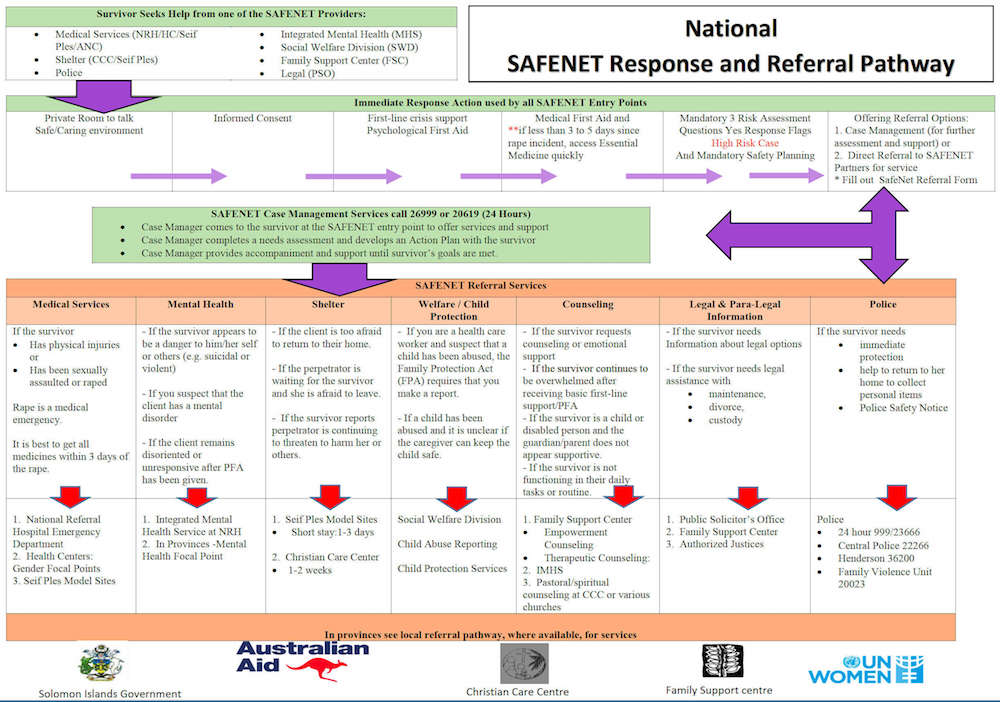
The Ministry is working closely with SAFENET to strengthen the SAFENET referral system for women victims and ensure quality services for all women in al provinces, and ensure accessibility for all women, including women with disability.

(SAFENET - A formal referral system comprising of both government and non-government agencies established to provide coordinated, frontline services and support to survivors/victims of gender-based violence.) 

16 Days of Activism Against Gender-Based Violence is an international campaign to challenge violence against women and girls. The campaign runs every year from 25 November, the International Day for the Elimination of Violence against Women, to 10 December, Human Rights Day.

Improved Economic Status of Women

There is a large gender gap between paid and unpaid work. Women make up just over half (56%) of all unpaid workers, and only one third (33%) of paid workers. There is evidence that some women do not have autonomy over their earnings, nor are they able to contribute to some household decisions. This affects their level of economic empowerment. Women’s economic empowerment is the ability of women to bring about positive changes in their lives and that of their families and societies as a result of their participation in economic activities.

Improving the Economic status of women is a policy priority of the government.  The Ministry is mandated by the Gender Equality and Women’s Development (GEWD) Policy to coordinate the government’s commitment to addressing gender equality and advancing the economic status of women in the Solomon Islands.

The National Strategy on the Economic Empowerment of Women and Girls (NSEEWG) is designed to enhance gender equality and improve the economic status of Solomon Islands women. 

The Strategy ensures women economically empowered, will enable them to contribute more to improving their children and families, work to strengthen their communities, participate in sustainable development, create more stable, just and equitable societies and importantly, in nation building.

Financial inclusion is one of key focus areas under the strategy on saving schemes targeting informal sector. The MWYCFA conducts training on financial literacy, saving schemes and access to affordable financial services for rural women and girls. Eighty-nine women savings clubs/ groups were established and trained across all 10 provinces. These savings clubs are closely monitored by the Provincial Women’s Desk Officers in their respective provinces.

Improved Access for Women’s Right to Sexual and Reproductive Health

Although health services in the country are free, geographic inequity of healthcare centres is an issue that makes accessibility harder for women – especially if they cannot afford costs for transportation or if they need to seek permission from their husband or partner to attend a Health clinic.

The Government recognises that there is a need to improve access to healthcare, and in particular to reproductive and sexual healthcare services, and to raise widespread awareness of women’s rights to sexual and reproductive health.

Improved access to Education and providing a supportive school environment.

Education provides an opportunity to change gender stereotypical mind-sets, thus it is a critical entry point for promoting gender equality. There have been improvements in the access to education for girls, but there are still barriers to full participation and enjoyment of the school process for these girls.

Net enrolment rates at secondary school are low for both girls and boys, and women made up only 38% of the total estimated enrolment in tertiary education in 2012 (ADB 2015).

The Government recognises that here is an urgent need to strengthen gender analysis into education policy plans and strategies to ensure gender equity in access to education.

Gender & Women’s Documents

Legislation - pdf Family Protection Act 2014 (390 KB)

Treaties -  pdf Convention on the Elimination of All Forms of Discrimination Against Women (90 KB)

Reports/Assessments

pdf Solomon Islands CEDAW Combined Initial, Second and Third Periodic Report 2012 (3.32 MB)

pdf Solomon Islands Country Gender Assessment (2.44 MB)

pdf Solomon Gender Equality - Where do We Stand? (1.78 MB)

pdf SAFENET Assessment - National Action Plan 2014-2016 (2.00 MB)

Policies and Strategies

pdf National Gender Equality and Women's Development Policy 2016-2020 (2.01 MB)

pdf National Policy to Eliminate Violence Against Women and Girls 2016-2020 (2.64 MB)

pdf A National Strategy for the Economic Empowerment of Women and Girls (2.31 MB)

pdf Women, Peace and Security National Action Plan 2017-2020 (1.81 MB)

The Divisions of the Ministry of Women, Youth, Children and Family Affairs (MWYCFA) carry out the Ministry’s functions by focusing on specific priority areas for development. These areas cover the Ministry’s mandate which includes gender equality and women’s development, youth development, the protection and development of children as well as the responsibility to put in place plans and policies to help the Ministry achieve its objectives. This role also requires the Ministry to coordinate the implementation of these plans and policies as well as put in place measures to monitor their progress and effectiveness.

Priority Areas

Gender Equality & Women’s Development

Youth Development & Empowerment

Children’s Development

National Protection Committee

Research, Policy & Planning

The United Nations define youths as persons between the ages of 15 and 24 years old without prejudice to other definitions by Member States. In the Pacific Islands region, the definition of youths vary between countries.

In the Solomon Islands, the newly launched National Youth Policy 2017-2030 (link to document) defined youths as ‘persons between 15 and 34 years of age.

Solomon Islands is a youthful nation. 70 percent of Solomon Islands’ population is below the age of 34 years. The country has a very rapid population growth rate, currently the highest among all Pacific Islands countries. It currently produces about 18,000 births per year about 50 births every day, which translates to an equivalent of 2 full classrooms every day.

The rapidly burgeoning youth population coupled with very limited opportunities in government, private and informal sectors call for innovative approaches to provide opportunities for social and economic empowerment to all young people as they leave the education system and join the employment and labour market.

Policy Issues and Constraints

Consistent with youths elsewhere in the world, youth in Solomon Islands aspire to be the best they can be. However their ability to achieve their dreams and aspirations are not entirely dependent on themselves. They are influenced by many factors, some of which are outside their scope of control and sphere of influence. These factors represent policy issues and constraints that need to be addressed to provide the enabling environment that will allow young people to cultivate their aspirations and help them realised their dreams.

  1. Key sectoral policy issues
    • Lack of employment & entrepreneurship opportunities
    • Education and training not equipping students with livelihood and work ready skills
    • Lack of effective strategy to enhance health and wellbeing for young people.
    • Lack of a strategy for sports, recreation and health for young people.
  2. Cross-cutting Policy Issues
    • Lack of a strategy for sports, recreation and health for young people
    • Gender equality and inclusiveness needs further strengthening
    • Integrate cultural and spiritual values and virtues into all youth programmes
    • Prioritise youths with disabilities
    • Address Rural –Urban drift
    • Poor access to relevant information on youth issues
    • Lack of facilities for youths
    • Embrace appropriate technology
    • Implications of population growth
  3. Policy Implementation, Coordination and Performance Management Issues
    • Poor Policy Coherence
    • No common Framework linking all stakeholders working in the youth space
    • No clear financing strategy for youth development
    • Ineffective Implementation
    • Ineffective governance and institutional arrangements
    • Poor performance management Framework- for monitoring and evaluation.


Solomon Islands National Youth Policy 2017-2030

The new 3-tier Policy framework for youth development in Solomon Islands comprises of the i) National youth policy 2017-2030 (NYP) , ii) Strategic Framework for Youth Development in Solomon Islands (SFYDSII) and iii) National Youth Empowerment and Entrepreneurship Strategy (NYEES).

The National Youth Policy 2017-2030 is the first of the documents from the 3 tier policy framework for youth development in Solomon Islands and sets out the direction that will guide the other two documents.

NYP 2017-2030 sets the overarching long term vision and mission for youth development and empowerment in Solomon Islands within the framework of the National Development Strategy (NDS) 2016-2035 and the Sustainable Development Goals (SDGs) 2030.

The policy provides an enabling environment where youth development and empowerment can be mainstreamed into other key sector strategies for sustainable national development and nation building.

The NYP 2017-2030 has one overarching policy goal – Youth Empowerment for Sustainable Livelihoods- Leave no one behind. Six (6) priority policy outcomes (PPOs) underpin the achievement of this overarching goal during the 2017-2030 plan period.

NYP Six (6) Priority Policy Outcomes (PPO)

PPO 1: Educational Empowerment - by 2030, the scope and content of education curricula delivered at all levels of the education system including formal, technical & vocational and non-formal education will; (i) properly equip students who progress to higher levels of education; and (ii) ensure all students leaving the education system at any level are adequately equipped with ‘appropriate skills sets’ to make them ‘work-ready’ and help them engage effectively in the labour market.

PPO 2: Economic Empowerment – by 2030; at least 75% of youths who are not in educational institutions have secure career pathways through formal or informal employment opportunities, entrepreneurship and other innovative economic opportunities to improve their livelihoods and quality of life.

PP0 3: Health & Wellbeing – by 2030; (i) 100% of youths are aware of and are practicing health living and lifestyles; and (ii) actively engage in cultural, spiritual, sporting and other physical activities to improve their health and holistic wellbeing.

PPO 4: Sustainable Development – By 2030; youths are empowered and equipped to be effective catalysts and enablers of sustainable development – (i) enhancing opportunities for green and blue economies; (ii) strengthening resilience to natural disasters and climate change; (iii) ensuring food, water and energy security; (iv) promoting the use of appropriate and sustainable technological innovations and interventions to support sustainable development; and (v) implementing activities to achieve the SDGs relevant to Solomon Islands.

PPO 5:  Leadership, Governance, Peace Building, Social Inclusion and Citizenship – by 2030; (i) youths are empowered as agents of positive change, participating in leadership, decision making and governance mechanisms including traditional leadership and governance at all levels including household, village, community, provincial and national levels; and (ii) contributing to long-term social harmony and cohesion, peace and security, gender equality, equal opportunity and national unity that leaves no one behind.

PPO 6: Evidence-based Approaches, Access to information and Provincial implementation strategies - By 2020, (i) decision-making on strategies, plans and programmes on youth development and empowerment will be evidence-based; (ii) youths will have greater access to information; and (iii) all provinces have developed and are implementing their respective provincial implementation strategies for youth development and empowerment, cognizant of established traditional leadership and ward governance arrangements in empowering youths within each province; (iv) the NYC will be rejuvenated and; (v) capacity of staff in the MWYCFA, Provinces and partner agencies are strengthened to effectively implement the NYP 2017 – 2030.

Youth Documents

pdf Solomon Islands National Youth Policy 2017-2030 (14.37 MB)

pdf Strategic Framework for Youth Development and Empowerment in Solomon Islands (14.71 MB)

pdf Solomon Islands National Youth Policy 2010-2015 (470 KB)

Standard Forms